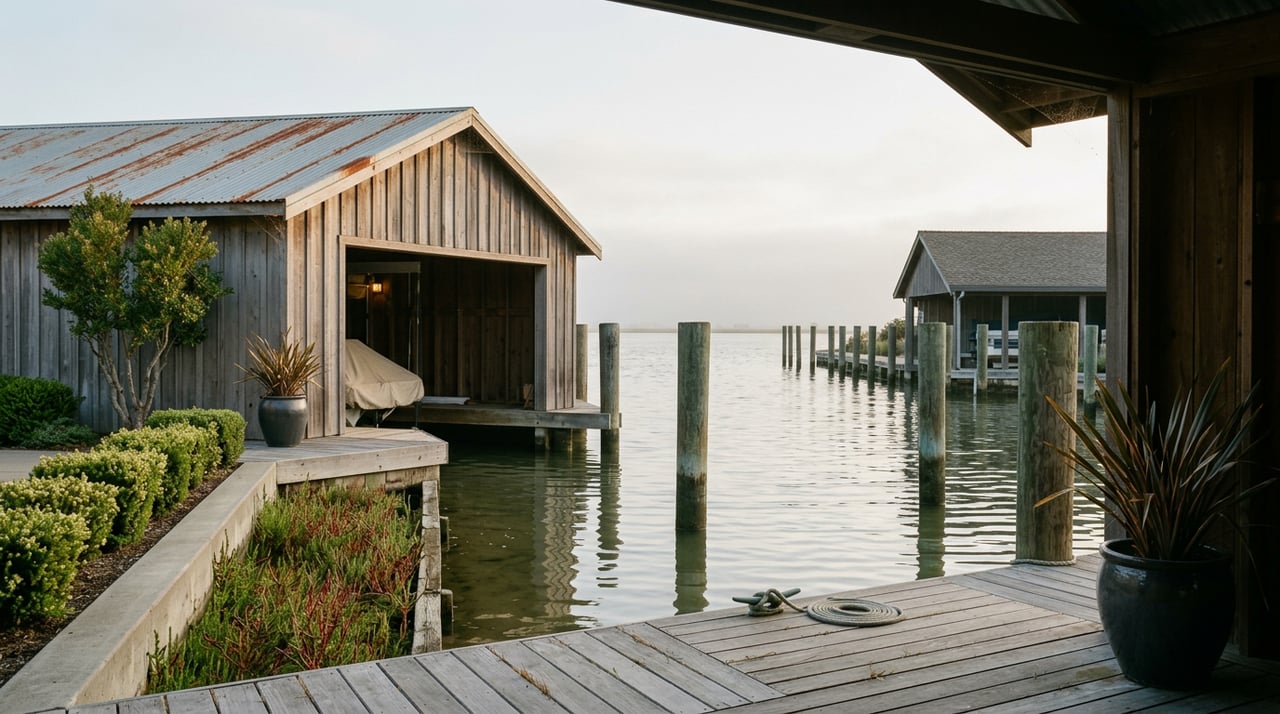
A dock reads like a feature on a listing sheet, the same way a renovated kitchen or a view corridor does. It sits in the description, it shows up in the photos, and buyers price it in mentally the way they'd price in square footage. But a dock behaves differently than a kitchen once escrow closes. A kitchen doesn't send you a bill five years later. A dock, depending on where it sits on the Tiburon Peninsula, can.
That difference is easy to miss because it never shows up in the number that gets the most attention: the median sale price. Two homes can list at the same figure and carry entirely different long-term cost structures, and the gap has nothing to do with square footage or finishes. It has to do with who governs the water underneath the dock, and how often that governance sends out a bill.
The Bill That Arrives Every Four or Five Years
Paradise Cay, the small waterfront enclave on the eastern shore of the Tiburon Peninsula, is an unincorporated pocket surrounded entirely by the Town of Tiburon, built in the 1960s on filled tidelands as one of the last permitted landfill projects allowed in San Francisco Bay. Just over 200 homes sit along its canals, many with docks built to hold boats up to 60 feet.
What makes Paradise Cay different from a typical waterfront neighborhood is that it isn't governed like one. It functions as its own County Service Area, CSA 29, a structure the Marin County Board of Supervisors created specifically so residents could levy special assessments on themselves to pay for the one thing every canal-front home eventually needs: dredging. Silt and mud settle into the waterways naturally, and if nobody removes it, boats stop being able to reach the docks that justified the home's price in the first place.
The county's own project records show what this actually costs in practice. The most recently documented full dredge, in 2024, was budgeted at roughly $998,000, took about six weeks starting in mid-August, and required the dredged material to be barged to the Alcatraz Island Disposal Site under U.S. Army Corps of Engineers permit conditions. That cost gets split across the assessed parcels through the CSA 29 special tax, and it recurs on a cycle. Marin County Public Works describes sediment removal in CSA 29 as occurring approximately every four to five years.
A buyer comparing two Tiburon-area homes with docks isn't just comparing two amenities. If one home sits inside CSA 29 and the other doesn't, one of those buyers is inheriting a recurring, lumpy capital obligation that has nothing to do with the mortgage, and the other isn't.
The Permit Clock Nobody Mentions in Escrow
Dredging is the recurring cost. Permitting is the deferred one, and it shows up the moment an owner wants to touch anything at the water's edge.
The Town of Tiburon is unusually direct about this on its own site. Its official guidance on permitting states plainly that the town requires permits that may not be typically required in other California cities, citing the peninsula's geologic and topographic conditions alongside heightened concerns about view protection, privacy, and aesthetics. One specific example: guard railings at waterfront bulkheads, fixed piers, and fixed gangways require both design review and a building permit before installation, not just a contractor showing up with materials.
That's the local layer. Above it sits a regional one. Any work that places fill, drives a piling, or alters the shoreline within San Francisco Bay typically falls under review by the San Francisco Bay Conservation and Development Commission, whose permit application tracker shows the volume and pace of projects moving through that process at any given time. Dredging and most in-water structural work add a third layer, federal review from the Army Corps of Engineers, the same agency whose permit conditions governed where Paradise Cay's 2024 dredge spoils could legally go.
None of this means a dock or seawall can't be repaired or replaced. It means the timeline for doing so runs on a different clock than a typical remodel, and that clock rarely gets mentioned until an owner is already trying to fix something.
Three Docks, Three Cost Structures
Not every dock on the peninsula carries the same exposure. The governance structure underneath it changes what an owner is actually signing up for.
| Paradise Cay canal-front | Open bay-front Tiburon | Belvedere Lagoon | |
|---|---|---|---|
| Governing structure | CSA 29, a county service area with special assessment authority | City of Belvedere, with lagoon-specific flood and shoreline rules | |
| Recurring maintenance | Shared dredging cost, roughly every 4 to 5 years | Dock and shoreline upkeep | Shared exposure to lagoon-wide flood and shoreline planning |
| Permit layers for shoreline work | Town design review, BCDC, Army Corps for dredging | Town design review, BCDC, Army Corps for in-water work | City of Belvedere review, BCDC, and often Army Corps |
| Flood exposure | Low-lying areas identified as vulnerable to future sea level rise | Varies by elevation and exposure to open bay |
The pattern across all three: none of them are simple. But Paradise Cay is the only one where the recurring dredging cost is structurally shared and documented through a public assessment mechanism, which is also why it's the one place a buyer can actually pull county records and see what past dredges have cost before writing an offer.
What the Median Price Actually Hides
Here's where the numbers get interesting, and where the gap between the headline figure and the real story opens up.
Combined Belvedere-Tiburon data for Q1 2026 showed a median home sale price of $3.3 million, up 25.5 percent year over year, with 38 sales closed in the quarter, a 52 percent increase in volume from the year before. Tiburon-only data covering the three months ending in May 2026 told a different story: a median price of $3.1 million, down 6.1 percent from the same period a year earlier, even as the average house price for the single month of May 2026 came in at $3.27 million, up 10.1 percent year over year, with homes selling in an average of 24 days.
Two data sets, two different directions, both describing overlapping stretches of the same peninsula. That's not a contradiction to explain away. It's a symptom of a market thin enough that a handful of transactions can swing the median in either direction depending on which homes happen to close that quarter, and whether those homes carry docks, CSA 29 obligations, or neither.
A market that noisy can't tell a buyer what a dock is actually worth or what it actually costs. Only the underlying governance and maintenance history can do that.
The median price tells you what sold. It doesn't tell you what the buyer is now responsible for maintaining.
Before You Write the Offer
For anyone comparing a waterfront home in Tiburon, Paradise Cay, or Belvedere Lagoon against a non-waterfront property elsewhere in Marin, a few steps of due diligence do more than any comparable sale can:
- Confirm whether the parcel sits within CSA 29 and request the assessment history, not just the current tax bill.
- Pull the county's dredging project records for the specific waterway the dock sits on, including timing and cost of the most recent maintenance cycle.
- Ask for any permit history or agency correspondence tied to prior dock, seawall, or bulkhead work.
- Order an inspection from a marine or structural engineer in addition to a standard home inspection, focused on the dock and any shoreline structure.
- Check the FEMA flood designation for the specific parcel.
- Verify dock ownership and any easements or shared-maintenance agreements through the title report and recorded deed.
A Few Questions Worth Asking Directly
Does every waterfront home in Tiburon belong to CSA 29? No. CSA 29 covers the Paradise Cay community specifically. Homes along other stretches of Tiburon's waterfront or in Belvedere Lagoon fall under different governance and don't share in Paradise Cay's dredging assessments.
Can a buyer add a dock to a Tiburon home that doesn't already have one? Sometimes, but it requires clearing town design review at minimum, and likely BCDC and Army Corps review if the work involves fill or in-water pilings. That process runs on its own timeline and shouldn't be assumed as a quick add-on.
Does a documented dredging or permit history hurt resale value? Not typically. A well-documented maintenance history, dredging records, permit files, and engineer inspections, gives a buyer confidence that the dock has been properly maintained. The absence of records is usually the bigger concern.
A private dock in Tiburon can be exactly the lifestyle asset it's marketed as. It can also come with a governance structure and a maintenance cycle that most buyers never think to ask about until they're already the ones paying for it. Knowing which category a specific property falls into, before an offer goes in, is the difference between an informed decision and an expensive surprise.
If you're weighing a waterfront property on the peninsula, or trying to understand what a specific dock, seawall, or CSA 29 parcel actually commits you to, Rick van der Wal can walk through the records with you before you write an offer. Let's Connect.
This article is general information, not legal, tax or financial advice. Consult a qualified professional about your situation.